
Reviewed by: Madhura Balasubramaniam, MA & Tina Aswani Omprakash, MPH
Medically Reviewed by: Aasma Shaukat, MD, MPH
This year, a few patient advocates from Team SAIA attended Digestive Disease Week (DDW) in Chicago from May 2nd–5th, 2026 to bring our patient community the latest & greatest updates in the GI space. The conference was packed with new research and innovations that are changing the IBD landscape for years to come. Below are our findings and takeaways from this year’s DDW that we’re excited to share with the patient community!
Poster Session: Can Metoclopramide Improve Quality of Colonoscopy Prep? (Sharan Khela)
While exploring the poster hall at DDW 2026, one study that stood out looked at whether adding metoclopramide to standard colonoscopy prep could improve the quality of bowel preparation. The study found that patients who used metoclopramide alongside their prep had significantly better bowel preparation scores compared to patients who used standard prep alone.
Metoclopramide is a medication commonly used to help with nausea and gastric emptying, which made this poster especially interesting to me from a patient perspective. As someone who has lived with Crohn’s disease for over two decades, colonoscopy prep has always been one of the most difficult parts of the process. The nausea, discomfort, bloating, and sheer amount of prep solution can feel overwhelming, and I know many patients feel the same way.
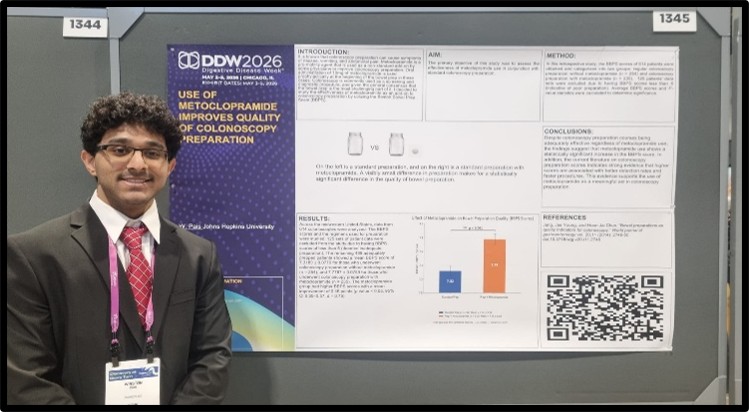
What caught my attention about this study was not only the improvement in bowel prep quality, but the possibility that a medication like metoclopramide could also help patients better tolerate the prep experience itself. Poor prep can lead to repeated colonoscopies, delayed procedures, and added stress for patients, so anything that can improve both effectiveness and tolerability feels incredibly important.
Why does this matter for us as patients?
- Colonoscopy prep is physically and emotionally exhausting for patients.
- Nausea is a huge barrier that can make it difficult to complete prep properly.
- Better bowel prep can improve visibility and reduce repeat procedures.
Of course, this was just one study, and more research would be needed, especially since the study was conducted in a general colonoscopy population rather than specifically in patients living with chronic GI conditions such as IBD and Gastroparesis. Further research could help understand whether the same benefits would be seen in patients who often face additional challenges when preparing for a colonoscopy. But as a patient advocate, I appreciated seeing research focused not only on disease outcomes, but also on improving the everyday patient experience. Sometimes small changes in care can make a huge difference in quality of life for patients navigating chronic illness.
The Ideal Anastomosis and the Impact of Diet on Anastomotic Leaks (Ian Goldstein)
I attended the Emerging Technologies: Endoscopic Anastomosis and Suturing session at DDW.
In this blog post, I want to highlight Dr. Michael F. McGee’s presentation on Newer Techniques for Surgical Anastomoses. An endoscopic anastomosis is a procedure in which a device called an endoscope is used to close holes or seal openings in the GI tract. Dr. McGee explained how this technique can be used to create an anastomosis. An anastomosis is a surgical connection between any two tubular structures in the body, like reconnecting two parts of healthy bowel after an intestinal resection.
Dr. McGee spoke in depth about what makes a good surgical anastomosis, and his conclusion was: “It’s all about leaks.” He said that what makes an anastomosis better is a low leak rate. An anastomotic leak occurs when fluid or contents escape from the area where sections of the bowel are surgically reconnected.
A still image of an ideal anastomosis was shown during the session, and the doctor detailed surgical innovations over the years. Technologically, even as evolutions have taken place, Dr. McGee emphasized the importance of doing the basics right, including selecting an anastomotic site with healthy tissue and a good blood supply. From a patient perspective, it was very important to hear Dr. McGee emphasize the importance of timing of surgery and nutrition. Dr. McGee highlighted the importance of ensuring that the surgery is timed and planned appropriately whenever possible, to avoid complications such as leaks. As patients, it is important for us to understand that surgery too functions as an important treatment option and is not a last resort only to be considered during emergency situations. A surgery that is planned ahead of time not only reduces leaks but also helps us recover well physically and mentally. Equally, Dr. McGee also emphasized the importance of nutrition and ensuring that the GIs, surgical teams and dietitians work together with patients to improve our nutritional status prior to surgery, including through enteral nutrition or parenteral nutrition, where possible.
In expanding this focus on the impact on diet on healing, Dr. McGee also introduced the idea of the microbiome and its role in healing. Dr. McGee said there is “growing recognition of the role that our microbiome plays in anastomoses and how they heal.” A 2020 study showed that mice fed a high-fat Western-type diet before surgery had higher rates of anastomotic leaks than mice fed a standard chow diet (low fat/high fiber), suggesting that diet may influence the bacteria involved in helping anastomoses heal.
This topic is particularly interesting to me because I had bowel resection surgery in 2022. While I didn’t suffer from anastomotic leaks, the staples used to create the anastomosis caused internal bleeding that I lived with for three years, until May 2025, when I underwent an anastomotic revision in which the surgeon used sutures instead of staples to reconnect the area. This worked, and since then I have been particularly interested in anastomotic surgical innovations. Just like there has been growing awareness and research on the role of diet in IBD and chronic GI conditions, Dr. McGee’s presentation also brought home the importance of diet and microbiome to surgery and surgical healing. It would be important for us as patients and caregivers to look out for this research as it grows.
New Insights into Early-Onset Colorectal Cancer (Basmah Ali)
At the Digestive Disease Week conference in Chicago, I attended a session which I feel is pertinent to everyone impacted by a growing health concern: Early-Onset Colorectal Cancer (EOCRC). In 2021, the recommended age guidelines for Colorectal Cancer (CRC) screening in the United States were lowered from 50 to 45 years of age.
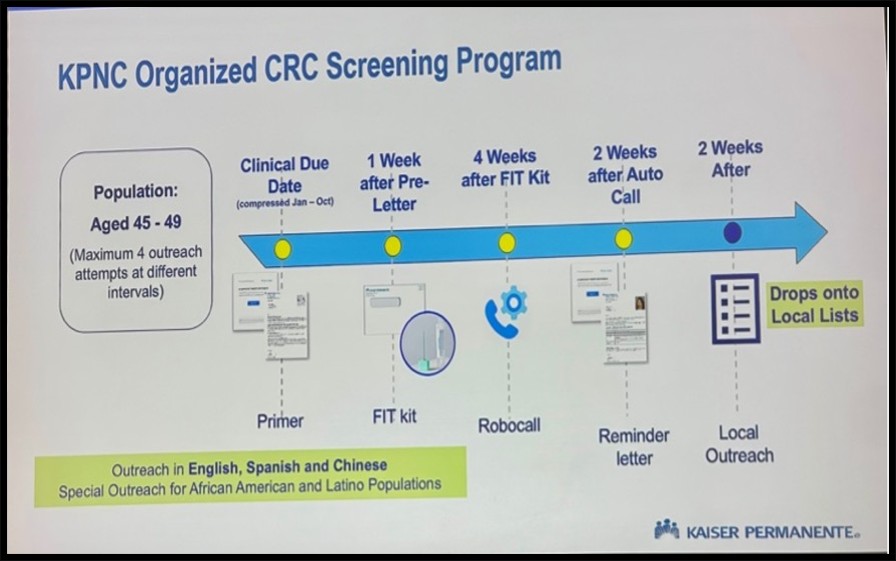
Dr. Jeffrey Lee at Kaiser Permanente shared an organized outreach program implemented in 2022 to increase screening primarily through mailed fecal immunochemical testing (FIT) for 45–49-year-olds of average risk in Northern and Central California. FIT kits were used as an accessible first-line screening tool, with individuals who received a positive referred for follow-up colonoscopy to investigate the cause and identify any precancerous polyps or CRC. The presentation compared screening rates using different methods, including FIT kits, colonoscopies, and sigmoidoscopies, before and after the guidelines changed. The results indicated that screening rates amongst this age group increased from less than 5% in 2018 to 50% in 2025, primarily due to the uptake in FIT kit distributions.
Why are these results important? Global EOCRC incidence rates are growing considerably, and concerns around younger adults developing CRC continue to increase. This was reinforced by a presentation from Pathiyil and colleagues, which found that mortality from EOCRC is rising in adults under 45, with rectal cancer deaths increasing at a particularly concerning rate. This is projected to continue rising through 2035. Together, these findings highlight the importance of improving awareness, recognizing symptoms earlier, and increasing access to screening.
Unfortunately, screening remains underutilized for many communities, and one of the reasons is lack of access. While it does not account for all the barriers, a program that can provide screening in the comfort of people’s homes, alongside appropriate follow-up care, is a step in the right direction to reduce the gap and improve outcomes for future generations.
Loss of Hunger: Approaching the GI Patient with No Appetite (Max Chaudhary)
DDW 2026 was full of compelling research showcasing new innovations and ideas. One session I want to highlight was When All Else Fails: Nutritional Considerations and Approaches in Challenging GI Conditions. The session included four interconnected presentations, each one showing different aspects of how GI manifestations play a role in conditions such as IBD, POTS/EDS, MCAS and how diet can be used to aid treatment. Loss of Hunger: Approaching the GI Patient with No Appetite was a presentation given by Dr. Kimberly Harer, MD. As a patient, I was thrilled to see diet and nutrition being discussed as a treatment option while also taking into account the patient’s mental health throughout. This could be a breakthrough in long-term patient care as it acknowledges both the physical and emotional aspects of GI disease.
Dr. Harer highlighted three kinds of hunger: Homeostatic, Hedonic, and Microbiota-driven signaling. Homeostatic hunger addresses our bodies’ metabolic needs when faced with energy depletion. Hedonic hunger focuses on the pleasure and reward part of our brain, satisfying a craving. Microbiota-driven signaling is all about the gut to brain connections and how gut hormones play a role in us feeling hungry.
When one of these types of hunger is impacted it can affect our overall appetite. Dr. Harer discussed how these hunger types can be promoted as well as stunted based on different factors.
Hormone imbalance, inflammation, neurological, medication side effects, and psychosocial factors could stunt hunger. Some examples of this can include IBD Flares, depression, SSRIs, ARFID to name a few. It can be difficult to pinpoint exactly what is causing the lack of appetite.
This session was meaningful to me because I’ve never had a doctor who asked me what I thought was causing my lack of appetite. I had never thought about this until I heard this lecture. Early on in my IBD journey, I struggled with a lack of appetite due to poor mental health. I was afraid to eat because of the pain it caused. My appetite was also affected because I was so fatigued that eating wasn’t even a thought. Nausea also played a role in my lack of hunger because I couldn’t keep food down. As I connected these dots in my own journey, I realized how these issues could better be addressed to improve treatment outcomes.
Dr. Harer then highlighted two calls to action. The first was encouraging providers to use what Kimberly called the “toddler interrogation method.” This method says that when a patient has no appetite, the provider asks questions including what that looks like and what does it feel like in your body. The second call to action was for GI teams to include more of a Multidisciplinary approach where the GI, a dietitian, and a GI behavioral therapist work together for the patient. The GI would be tasked with figuring out the GI conditions and medical pieces of care, the dietitian focuses on establishing healthy and sustainable eating habits that address any nutritional deficiency, and the therapist helps with any issues tied to mental health that impact the patient. It’s crucial that the patient is seen as part of the team and plays a role in shared decision-making, giving them an active role in their own care.
Concluding Thoughts
It is an honor for us, as patient advocates, not only to attend DDW this year, but also to share the insights and lessons we gained from leaders in the IBD and GI space. Our experiences with SAIA’s Clinical Research Roundtable, along with the diverse range of conference sessions we attended, made this year’s DDW especially meaningful. As our community continues to grow and medical advancements progress, we remain hopeful that we can help make care more accessible, effective, and supportive for everyone living with GI conditions.